Generic AI tools answer aviation compliance questions from whatever a general-purpose model absorbed in training or finds on the open internet. Aviation tools that have added an AI assistant still let it draw on whatever a general-purpose model finds. Trustworthy AI in safety-critical authoring needs something different from either, and it starts with where the model is allowed to look.
The AI conversation in aviation moved from theoretical to operational faster than most safety teams expected. Two years ago the live question was whether AI had any place near safety-critical documentation. Today the live question is which AI tool a Compliance Manager, Technical Author, or Head of Airworthiness can defend in front of an auditor. The choice of authoring tool decides which information sources end up shaping a published manual, and that choice is now central to every documentation decision aviation organisations face.
Two patterns dominate the market. The first is the generic large language model wrapped inside a productivity tool, with ChatGPT in a browser, Copilot inside Word, and Gemini in Google Docs as the most common examples. These tools draw on whatever the model absorbed in training or finds on the open internet, which is fast and convenient, and which is also why a Compliance Manager cannot trace what informed any given paragraph. The second pattern is the aviation authoring tool that has added an AI assistant. These tools can be utilised around aviation workflows, but the AI assistant still draws on whatever the vendor’s general-purpose model happens to find.
Neither pattern is sufficient for an operations manual, a Maintenance Organisation Exposition, a Continuing Airworthiness Management Exposition, or any training document where every page might end up in front of a regulator. SmartDocs was built on the principle that trustworthy AI in safety-critical authoring requires three things at once: grounding in verified sources under controlled governance, transparent citation back to those sources, and human review of every suggestion before it lands in published text. The rest of this article explains what each of those means in practice.
How grounding works in SmartDocs
In SmartDocs, a grounded model retrieves information from a defined source before it responds, rather than relying only on what it absorbed during training. That source is a controlled document store: the system looks up the relevant passages, uses them to compose its answer, and cites the passages it drew from.
In safety-critical aviation authoring, grounding has to meet three conditions. The controlled source has to be current, because regulations change and a citation is only useful if it points to the version in force. It has to be specific to your organisation’s own documents and to the regulations you operate under, because a generic aviation source gives generic answers. And it has to be auditable, which means a citation leads back to a specific passage in a specific document at a specific version.
SmartDocs grounds its suggestions in two layers. The first is your organisation’s own document library. Every manual published inside SmartDocs becomes part of the grounding context for your organisation and stays isolated to it, so when an author asks the system to draft a new section, the model can draw on the rest of your published manuals as it composes the answer. The second layer is SmartRegs, a managed repository of aviation regulations that TrustFlight maintains across EASA, FAA, and APAC regulatory sources, with a sixty-day service level on regulatory updates. SmartRegs is the source the AI consults for regulatory questions, and the open internet is firmly outside the scope of what it can reach.
The effect is that the room for hallucination shrinks. A model asked to write about EASA Part-CAT requirements does not draw on whatever it absorbed from the open internet during training. It consults the EASA regulatory texts that TrustFlight maintains inside SmartRegs and returns a response that cites the specific paragraph it drew from. The author who receives the suggestion can verify it against the linked source before deciding to accept the change, and the record of that verification stays visible months or years later.
Why every suggestion still meets a human
Grounding makes AI suggestions more reliable. Human review of every suggestion is what makes the system defensible in every case. SmartDocs is built so that an AI suggestion never becomes published text without a named author accepting it. The author can accept the suggestion as written, edit it before accepting, or reject it outright. The system records which action was taken, by whom, and against which version of the source documents. The author keeps editorial responsibility, and the platform supports them in discharging it.
The reason this matters goes beyond what any AI system can or cannot do. Aviation has always required a named, accountable individual at the end of every decision chain, and that principle does not change because the drafting tool is more capable. A controlled manual is an operational commitment the publishing organisation is accountable for under its approval. The author who signs off on a section is the organisation’s representative for that commitment. No AI suggestion changes that allocation of responsibility, and no audit will accept that it does.
The practical experience for a Technical Author working in SmartDocs reflects this. The AI assistant is fast and helpful for drafting, restructuring, and identifying references that need to be checked, and the workflow always ends with an author decision. The audit trail captures the AI’s contribution as one input among several, with the author’s edit history alongside it.
Where SmartRegs fits in the picture
SmartRegs is a companion product to SmartDocs within the Centrik ecosystem, giving compliance teams access to a managed, continuously updated regulatory library that integrates directly with the authoring workflow. SmartRegs is where the regulatory grounding comes from.
When an author working in SmartDocs links a manual section to a regulation, the system maintains a monitored link to the corresponding passage inside SmartRegs. When that passage changes, whether through an amendment, an EASA Notice of Proposed Amendment, or a structural revision of the regulation, every linked manual section is flagged for review. The author sees that the regulation has moved, which of their sections need to respond, and the difference between the old and new regulatory text, so they know what kind of change is required.
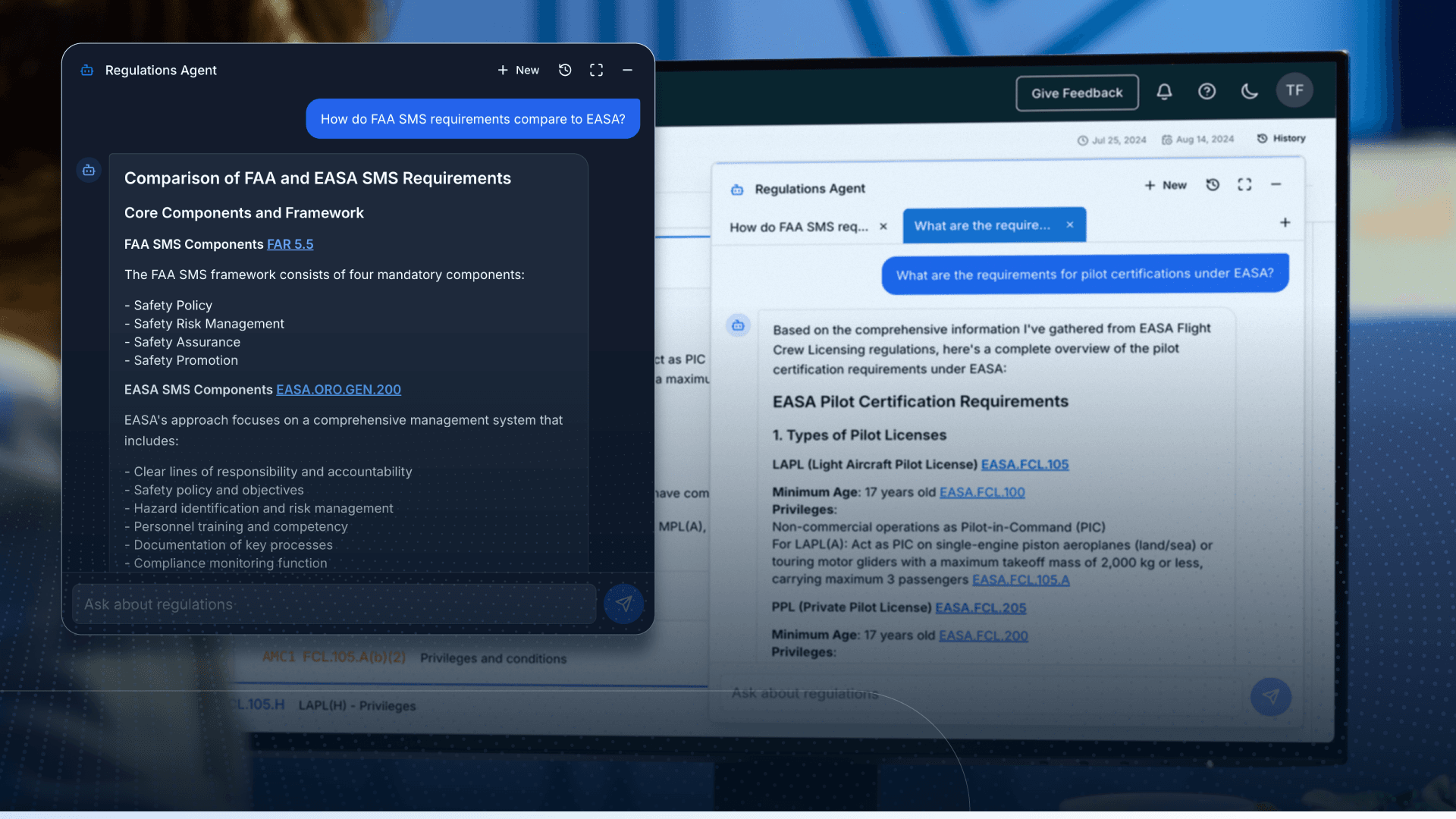
The SmartRegs AI agent is a separate assistant from the SmartDocs author tool, and it has no access to the open web. The decision is deliberate. A Compliance Manager asking about a specific EASA training requirement wants an answer drawn from the EASA regulatory text TrustFlight maintains inside SmartRegs, with a citation to the specific paragraph, rather than commentary gathered from the open internet. The SmartDocs AI agent can be configured to allow web search where the use case justifies it, though it defaults to internal sources for the same reason.
What the auditor sees
The test of a trustworthy AI claim is what an auditor finds when they ask how a given paragraph in a published manual came to be the way it is. In a generic AI workflow, the answer is opaque, because the suggestion came from a model with no audit trail and there is no way to reconstruct what informed it. In SmartDocs, the answer is concrete. The audit trail shows which sources the AI consulted when it composed the suggestion, the version of those sources at the time, the named author who accepted or edited the suggestion, the date and time of the decision, and the comments any reviewer added during the review and approval workflow before the change was published.
This is a difference in what the platform makes recoverable. An organisation using Word, SharePoint, and a generic AI tool can be disciplined about process and still struggle to reconstruct where a paragraph came from, because the tools were not built to preserve it. An organisation using SmartDocs has that provenance preserved by default, as a byproduct of how the system was designed.
Where to take this next
If your team is evaluating AI-enabled documentation tools, the most useful next step is a demonstration of SmartDocs against the questions your IT and compliance teams will need to answer. Please get in touch. We would be happy to discuss how SmartDocs can help transform your organisation.