A TrustFlight Perspective
The Flight Safety Foundation’s 2025 Safety Report, published in February 2026, presents a sobering picture of an aviation ecosystem under growing pressure. While total commercial airliner accidents fell 28% in 2025, fatalities rose sharply, 420 passengers and crew lost their lives across 12 fatal accidents, compared to 268 in 2024. Corporate aviation fared even worse: 34 accidents, 13 of them fatal, claiming 57 lives, the worst year for business jet fatal accidents in at least nine years.
Most striking of all: midair collision–related events in 2025 numbered four, more than the total for the previous five years combined.
The message is unambiguous. The skies are getting more complex, more congested, and more dangerous. And the safety systems that protected aviation in the past may no longer be sufficient for the airspace of the present.
In this article
The Convergence Problem
Aviation has always involved managing risk. What has changed is the density of competing interests sharing finite airspace. The FSF report identifies this directly: airlines continue to expand, but they are no longer the only growth driver. Business aviation demand remains strong. Helicopter operations are scaling. Uncrewed systems, drones, eVTOL, autonomous platforms, are adding volume, variety, and complexity that the existing architecture was never designed to absorb.
Near high-density terminals, the result is what the FSF calls “mixed-use airspace”: a convergence zone where military flights, commercial jets, general aviation, and rotorcraft intersect, often governed by procedures designed for a simpler era. The risk isn’t hypothetical, it is measurable, recurring, and accelerating. What the data consistently shows is that warning signals exist, but are too often not converted into timely mitigations.
FSF President Hassan Shahidi put it plainly: “Managing that convergence requires shared accountability: clear procedures, interoperable equipage, data-driven oversight, and decisive action.”
The Gap Between Safety Culture and Safety Capability
There is no shortage of safety intent across the aviation industry. Operators invest in training, comply with regulatory frameworks, file reports. But intent without infrastructure is fragile. The FSF report identifies a critical vulnerability: the global safety learning cycle is breaking down. Final accident investigation reports have been published for only 58% of airline accidents from 2020–2024, and only 41% of fatal accidents. Lessons that should be circulating through the industry are instead sitting in unfinished files.
The underlying challenge is that many operators are still running safety management systems built for a different risk environment: reactive rather than proactive, compliance-driven rather than risk-driven, siloed rather than integrated. In that model, safety is something you demonstrate after the fact. You file the report. You close the finding. You move on.
But reactive safety is fundamentally incompatible with an airspace in which the unexpected is increasingly routine. When risk is systemic, baked into converging traffic patterns, understaffed ATC facilities, and procedures that haven’t kept pace with operational reality, there is no reactive fix. You have to see it coming.
Proactive Safety: From Principle to Practice
The shift from reactive to proactive safety isn’t new as a concept. ICAO’s Safety Management Systems framework has long emphasised hazard identification, risk assessment, and safety assurance as core pillars. What has changed is the technology available to make those principles operationally real.
TrustFlight’s Centrik 5 is the proven, trusted foundation for safety, quality, and risk management, used by 200,000+ aviation professionals across 100+ countries. Where previous-generation systems collected reports and closed findings, a platform built for today’s complexity does something fundamentally different: it surfaces patterns before they become accidents.
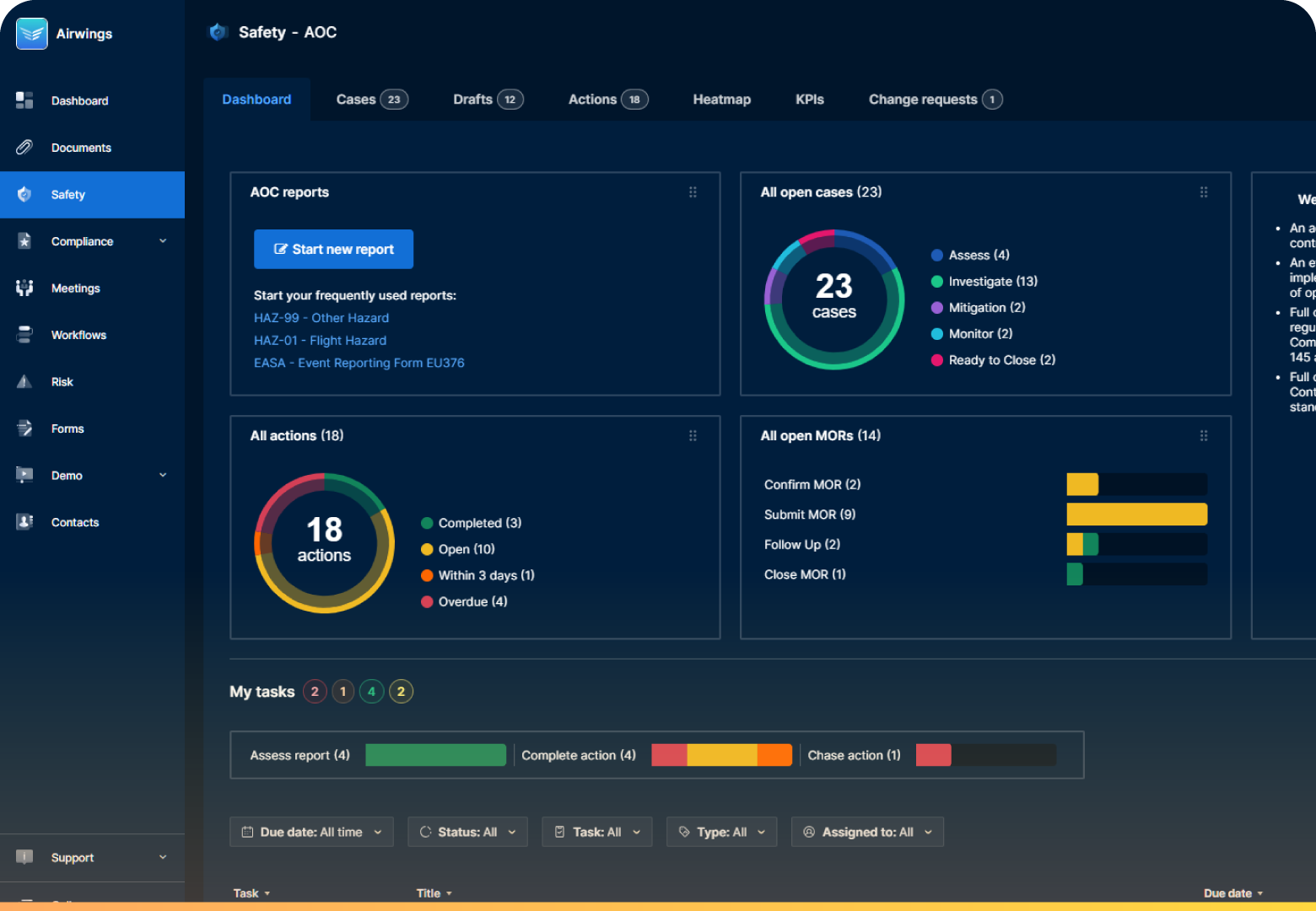
Centrik 5’s approach centres on multi-hazard, multi-consequence risk assessments that are directly linked to SMS reports and compliance findings, not stored in separate silos, but integrated into a single operating picture. When a safety event is captured, even via voice, embedded AI classifies risk levels and surfaces trends in real time. Managers can assess incidents, instigate corrective actions, and monitor progress through role-based dashboards that make safety performance visible at every level of the organisation, from the front line to the boardroom.
This matters particularly in the context of mixed-use airspace. An operator sharing congested terminal environments with multiple aircraft types isn’t just filing reports, it’s building a continuously updated risk picture. When recurring proximity events appear in the data, they don’t fade into background noise. They trigger risk assessment workflows. They prompt action before the next approach.
Regulatory Complexity Is Also Increasing
It would be a mistake to think of the challenge as purely operational. The regulatory landscape surrounding complex airspace is itself in flux. New frameworks governing uncrewed aircraft systems, drone corridors, and urban air mobility are being developed simultaneously by EASA, FAA, ICAO, Transport Canada, and dozens of national aviation authorities, often on different timelines and with different requirements.
For operators who already struggle to keep pace with regulatory change, this is a compounding pressure. Centrik 5’s continuous monitoring of over 120 global regulatory frameworks, with automated detection of amendments and updates, means that compliance doesn’t depend on someone reading the right circular at the right time. The system does the watching so operators can focus on the flying.
What 2025 Tells Us About 2026
The FSF’s three priorities for action, reducing mixed-use airspace risk, strengthening system capacity and resilience, and restoring the global safety learning cycle, are not abstract goals. They are a call to convert known risk into sustained risk reduction. That language is deliberate. The risks are known. The question is whether the industry will act on them before the next convergence zone demands a reckoning.
Centrik 5 was built for exactly this moment: not to administer compliance after the fact, but to make safety an active, continuous, intelligence-driven discipline. Across 1,600+ organisations in 120 countries, TrustFlight has watched the industry’s safety challenges evolve in real time. The pattern is consistent: the organisations that weather complexity best are those that treat safety management as a living system, not a static requirement. That is the principle at the heart of TrustFlight, aviation’s safety intelligence platform, connecting technology, specialist training, regulatory expertise, and emergency preparedness and response into a single, connected view of operational risk.
As airspace becomes more contested, the margin for error narrows. Proactive safety isn’t a competitive advantage. It’s the baseline requirement for operating in the skies ahead.
TrustFlight is aviation’s safety intelligence platform, integrating proven technology, specialist training, regulatory expertise, and emergency preparedness and response. Centrik 5 is the trusted foundation for safety, quality, and risk management, relied on by 200,000+ professionals across 100+ countries. We serve 1,600+ organisations in 120 countries because we don’t just deliver software, we deliver the operational intelligence and expertise to act on it.
Frequently Asked Questions
What is proactive safety management in aviation?
Proactive safety management in aviation means identifying and mitigating hazards before they lead to incidents or accidents, rather than responding after the fact. It involves continuous risk assessment, safety reporting, trend analysis, and corrective action, typically underpinned by a Safety Management System (SMS) aligned with ICAO standards. Tools like Centrik 5 enable operators to link safety reports, risk assessments, and compliance findings in a single system, surfacing emerging risks in real time.
What is mixed-use airspace and why is it dangerous?
Mixed-use airspace refers to airspace shared by multiple categories of aircraft, commercial jets, military aircraft, general aviation, helicopters, and increasingly uncrewed systems, often near busy terminal environments. It is considered high-risk because different operators may use different procedures, communications standards, and equipment, creating gaps in situational awareness and coordination. The Flight Safety Foundation’s 2025 Safety Report identified mixed-use airspace risk near high-density terminals as one of three urgent priorities for the global aviation community.
What does the FSF 2025 Safety Report say about aviation safety trends?
The Flight Safety Foundation’s 2025 Safety Report found that while total commercial airliner accidents declined 28% year-on-year, fatalities rose sharply to 420, up from 268 in 2024. Corporate jet fatal accidents reached their highest level in at least nine years. Midair collision-related events in 2025 numbered four, exceeding the combined total of three recorded across the entire prior five-year period. The FSF identified three priorities: reducing mixed-use airspace risk, strengthening system capacity and resilience, and restoring the global safety learning cycle.
How does Centrik 5 support aviation safety management?
Centrik 5 is TrustFlight’s proven safety, quality, and risk management platform, used by over 200,000 aviation professionals across 100 countries. It supports proactive safety management through multi-hazard risk assessments linked directly to SMS reports and compliance findings, AI-powered risk classification and trend identification, real-time dashboards, voice-enabled safety reporting, and continuous monitoring of over 120 global regulatory frameworks including EASA, FAA, ICAO, and Transport Canada. Centrik 5 is the established foundation of TrustFlight’s broader safety intelligence platform, which encompasses technology, specialist training through Baines Simmons, security assurance through Redline, and emergency response through Kenyon International.
What regulations govern aviation safety management systems?
Aviation Safety Management Systems are primarily governed by ICAO Annex 19, which sets the international standard for SMS implementation. Regional regulators including EASA (through Part-ORO and related regulations), the FAA (through AC 120-92B), Transport Canada, and numerous national authorities have developed their own SMS frameworks aligned with ICAO standards. As airspace complexity grows, particularly with the integration of uncrewed aircraft systems, regulatory requirements are evolving rapidly, making continuous compliance monitoring an essential capability for aviation operators.